
(Un)erased Heritage
Some places have disappeared from the landscape. Some houses fell into disrepair and turned into ruins. Some people were forced to leave their homes. Yet their stories remained. Seventy-five years ago, the inhabitants of Lešť and Turie Pole had to leave their native villages forever because of the
Some places have disappeared from the landscape, yet their stories remain.
The story we want to share with you commemorates two villages whose inhabitants were forced to leave their homes 75 years ago.
It is the story of Lešť and Turie Pole.
For centuries, both villages were vibrant communities where generations built their homes, cultivated the land, raised children and passed down customs, songs, crafts and folk costumes. Despite harsh conditions, strong communities grew here, firmly connected to the landscape and the place they regarded as their ancestral home. In the mid-20th century, however, this world was abruptly disrupted by the decision to expand a military training area. The inhabitants had to leave their native villages and dispersed across Slovakia. They left behind houses, fields, churches, cemeteries and places bound to the stories of previous generations.
The villages gradually disappeared, but their memory did not. People took with them what they could: photographs, folk costumes, embroidery, songs and small objects, but above all memories. Thanks to these, we can now piece together at least part of the world that ceased to exist physically.
(UN)ERASED HERITAGE
The new collection continues the story of the exhibition of the same name, created jointly by our atelier and folk-costume collector Daniela Šuleková to mark the 75th anniversary of the displacement of both villages. Its centrepiece is a group of rare preserved folk costumes and costume components from Daniela Šuleková’s collection. They are among the last tangible testimonies to life in villages that no longer physically exist.
The exhibition also includes six exclusive one-of-a-kind pieces—original jewellery inspired by embroidery patterns from the traditional costumes of Lešť and Turie Pole. Each was made as a single, unique piece and will be auctioned in December 2026.
One of the exhibition’s main aims is to help fulfil Daniela Šuleková’s long-held dream of creating a publication devoted to embroidery from the vanished villages of Lešť and Turie Pole, documenting it professionally and preserving it for future generations. The exhibition is therefore connected, through the Petra Toth Foundation, with the public fundraising campaign “Publication of Embroidery from the Vanished Villages of Lešť and Turie Pole”. A contribution from every product sold from the (Un)erased Heritage collection, as well as part of the exhibition admission fee, will support the campaign. The funds raised will be used to publish “A Legacy in Needle and Thread – Embroidery from the Vanished Villages of Lešť and Turie Pole” and to cover the costs associated with its creation.
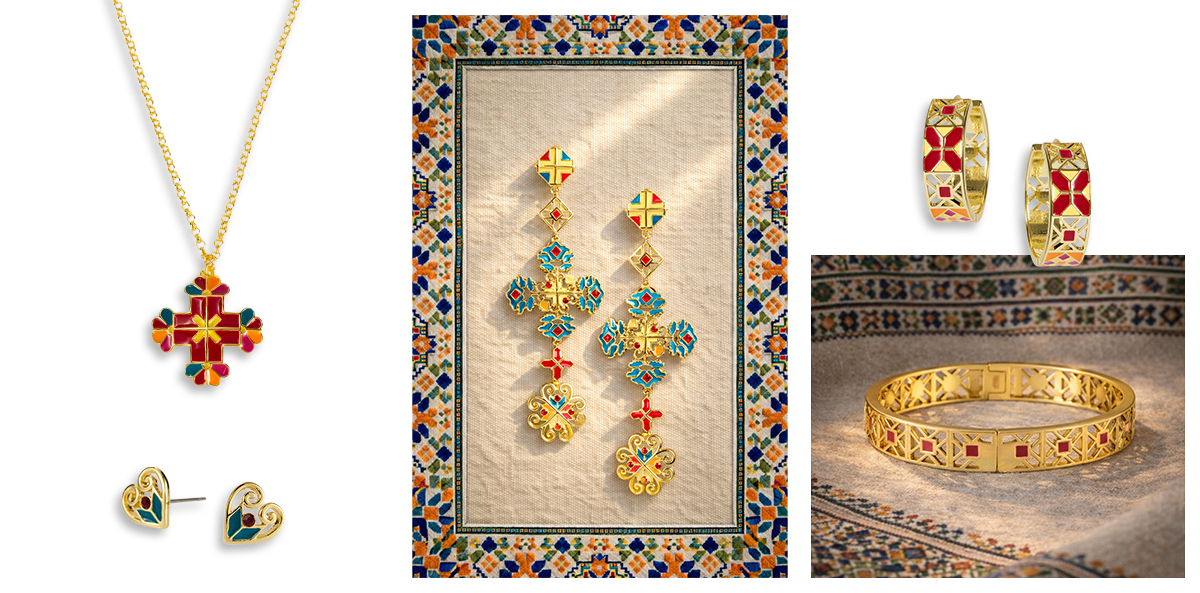
FRAGMENTS OF CULTURAL MEMORY
The villages of Lešť and Turie Pole were known for the widespread use of bobbin lace, distinguished by restraint and harmony as well as a wealth of patterns. Its ornamentation drew mainly on geometric motifs. It was usually white or matched the colour of the fabrics used, although orange, red or yellow embroidery thread was also incorporated. It decorated skirts too; women would pin up the side of the overskirt so that the lace could be seen.
We transformed original motifs from the folk costumes of Lešť and Turie Pole into contemporary original jewellery with a gold finish and added jewellery enamel in rich shades taken from the original embroidery. The result is a unique range of earrings, bracelets, necklaces, rings and a brooch.
We also transferred the collection’s motifs to other products: a wallet, cosmetic bag, mirror, belt and key ring.
Each carries a small fragment of the heritage of places that no longer exist.
The products in the collection thus continue the story we want to share with you. Traditions do not have to remain enclosed in display cases. They can become a natural bridge between past and present and carry forward the legacy of a vanished heritage.
Because not everything that disappears is lost.